
Updated: 2026-08-04
Sleep timer or all night? How to run an air conditioner on hot summer nights
Manufacturer tests on room temperature, WBGT, and electricity use help explain when an overnight setting may be more practical than a sleep timer.
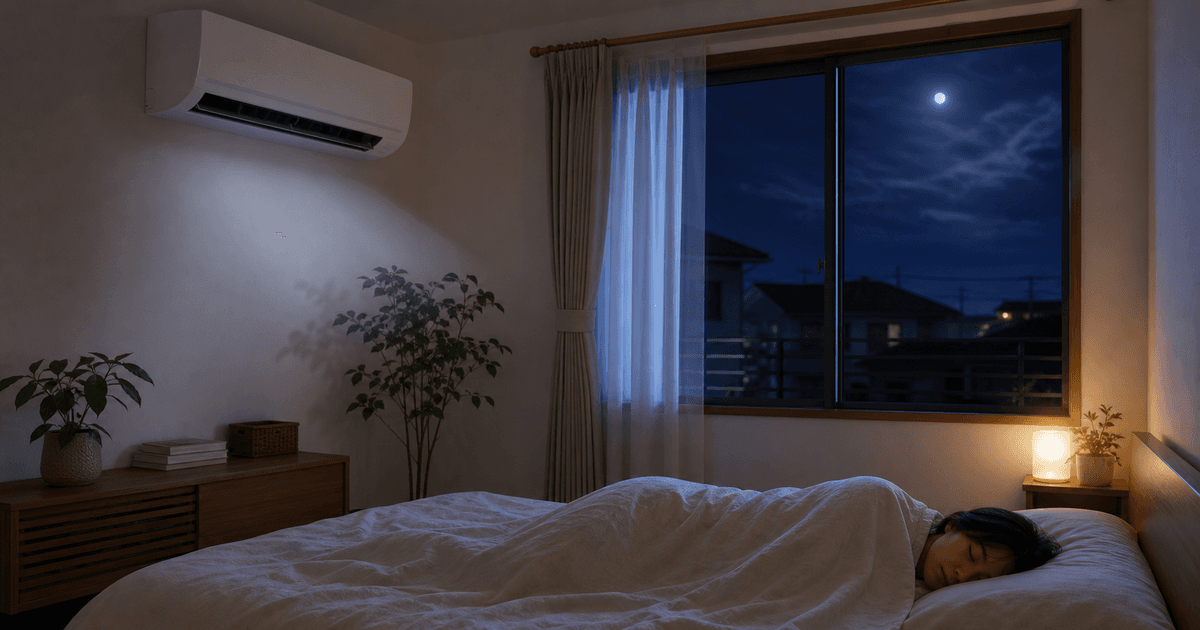
Short Answer
On a hot or humid night, running the air conditioner at a moderate setting until morning is more likely to prevent the room from heating up than switching it off after a few hours. Electricity use and a comfortable setting vary with the model, room size, insulation, outdoor conditions, and the people sleeping there. Pre-cool the room, avoid continuous direct airflow, and do not insist on a sleep timer if heat regularly wakes you.
Checklist
- ・Consider overnight operation when the night remains hot or humid
- ・Do not treat one laboratory electricity-cost figure as your household bill
- ・Start before bedtime and direct airflow away from the body
- ・If it feels cold, adjust temperature, airflow, or dehumidifying before switching off
- ・Prioritise individual health needs and professional medical advice
- ・Stop and seek inspection for unusual noise, burning odor, leaks, or repeated shutdowns
On tropical nights, overnight operation can keep conditions steadier
In a 2026 Panasonic test using a six-tatami environmental chamber, continuous cooling kept the room at 26–27°C throughout an eight-hour simulated night. With a three-hour off timer, the room reached 28.6°C thirty minutes after shutdown and 31.2°C by the end. A Daikin test in a home also found that WBGT rose after timed shutdown and could reach a heat-illness caution level toward morning. These results apply to their stated conditions, but they illustrate why a humid bedroom can become hot again after cooling stops.
Read electricity figures together with the test conditions
In the same Panasonic test, the estimated eight-hour nighttime cost was 26.7 yen for continuous operation and 11.5 yen for a three-hour timer, a difference of 15.2 yen. The calculation used specific conditions, including 30°C outdoor temperature, 90% humidity, a 28°C cooling setting, and a six-tatami chamber. Your tariff, equipment efficiency, room size, insulation, and stored daytime heat will change the result. Treat the figures as one comparison, not a guaranteed nightly bill.
Use the overnight forecast and bedroom conditions to decide
A room is more likely to heat up after shutdown when the outdoor temperature stays high, humidity is elevated, or a top-floor or west-facing room retains daytime heat. Check the forecast and, if available, a bedroom thermometer and hygrometer. If heat has woken you on similar nights, overnight operation is often the more practical choice. A timer or gentler operation may be enough when outdoor conditions cool substantially and the closed room does not warm quickly.
If it feels too cold, adjust airflow before switching off
Raise the set temperature, use automatic or lower fan speed, and aim the louvers so air does not blow continuously onto the body. If the model has sleep, dehumidifying, or mild-dehumidifying modes, check the manual because their behaviour differs. A mode name alone does not guarantee lower electricity use.
There is no single temperature for every person
Japan's Ministry of Health, Labour and Welfare advises choosing a cool place such as an air-conditioned room, drinking early, and watching for changes in condition to prevent heat illness. Comfort and risk vary with age, bedding, clothing, and health. For older adults, infants, people receiving treatment, or anyone with reduced temperature awareness, prioritise their condition and medical advice. Call emergency services if a person is unconscious or cannot drink independently.
Some symptoms need inspection, not a different timer
Weak cooling despite a lower setting, repeated shutdowns, unusual loud noise, a burning odor, or water leakage point to a condition beyond timer choice. Check only the filter and user-serviceable items described in the manual. If the problem remains, stop forcing the system to run and arrange an inspection. Tokai Home Everything can review model, installation, and error-display photos for homes primarily in Nagoya.
Need help with the actual work?
Photos and a short description help us understand what work may be needed.