Updated: 2026-10-04
Nagoya, West Owari, East Owari and Chita
Air conditioner not cooling or heating? A safe check order for Nagoya homes
A practical order for checking weak cooling or heating, including defrost behavior, indoor leaks, refrigerant limits, and four documented Nagoya service cases.
Short Answer
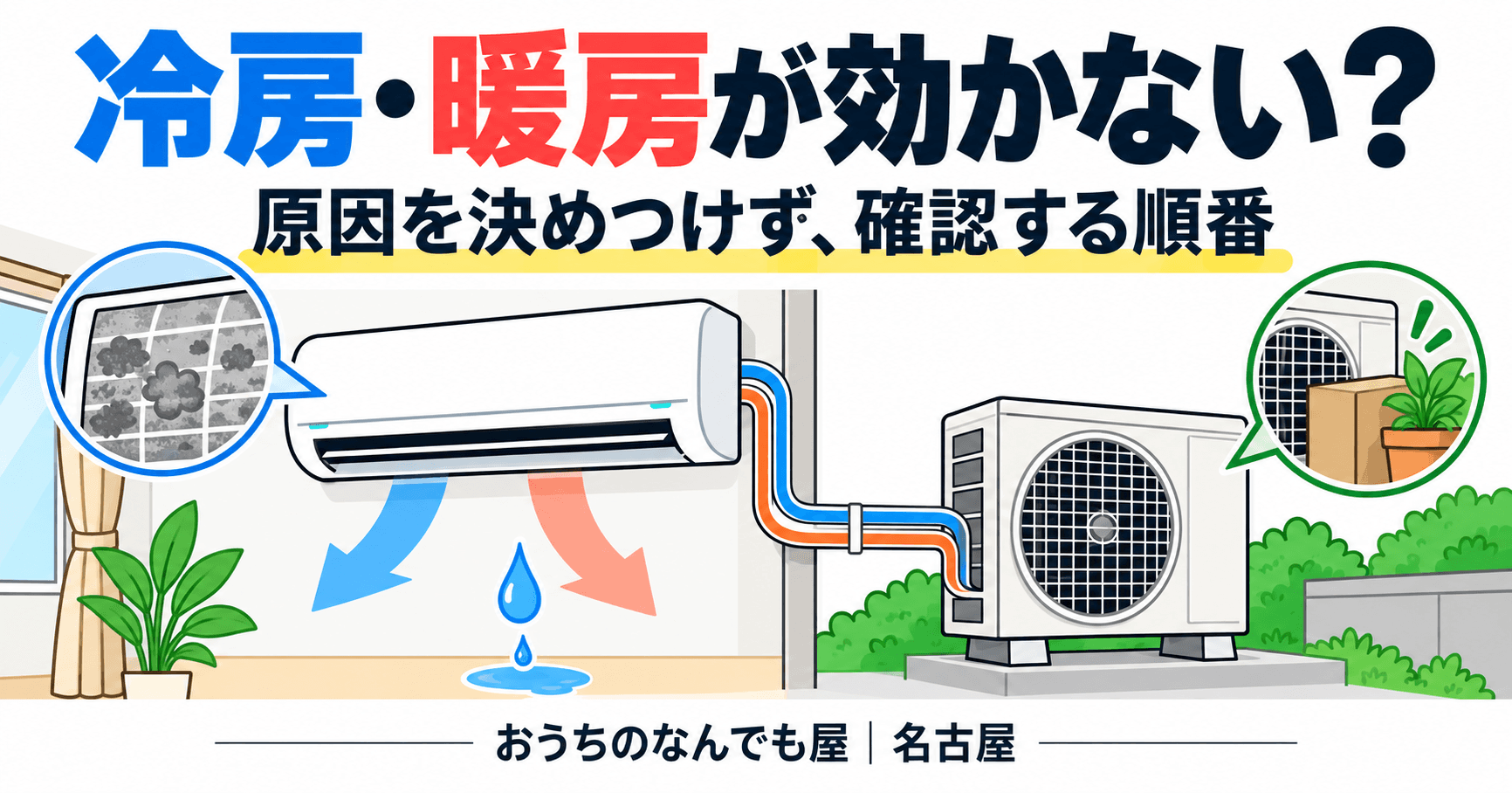
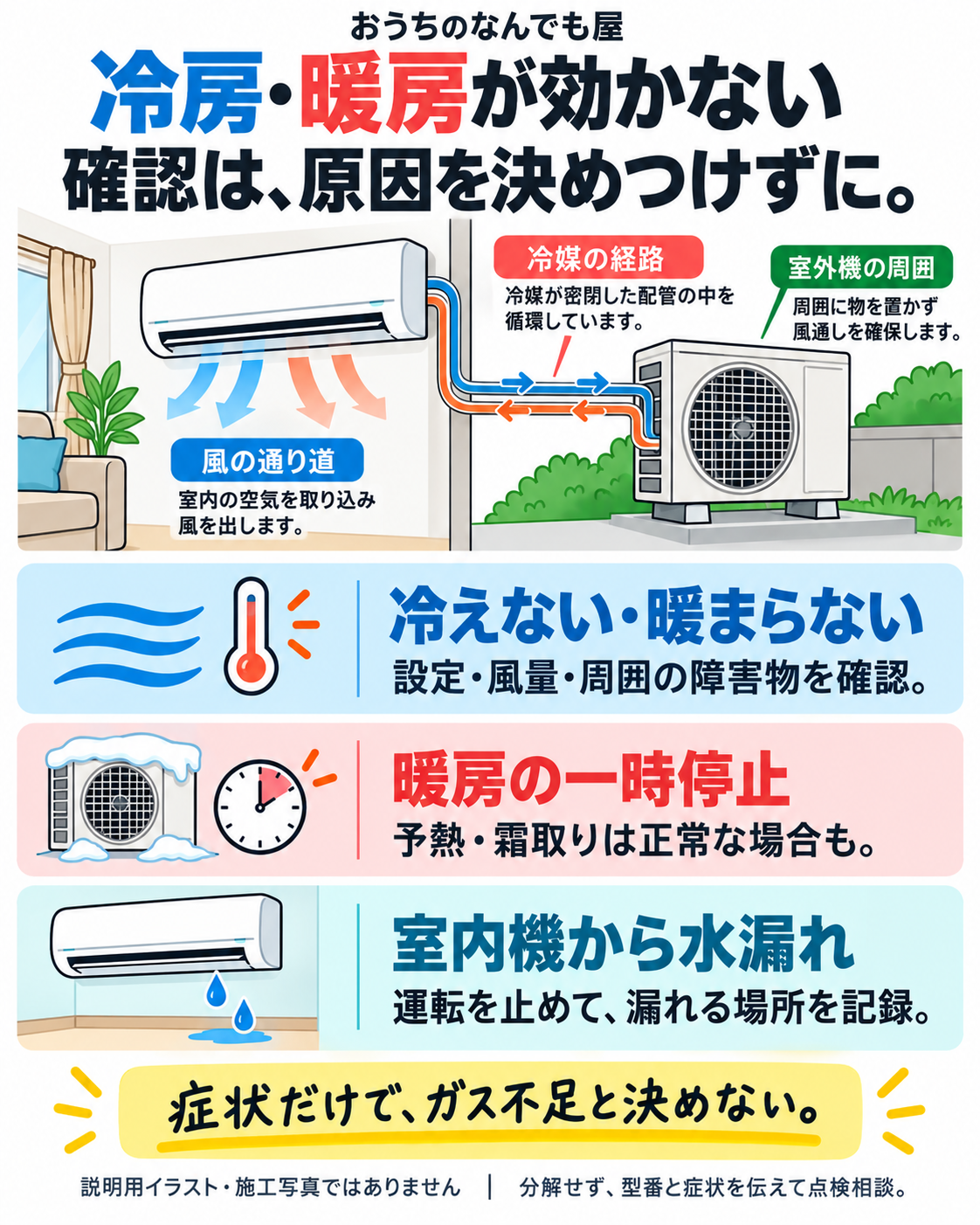
If there is no burning odor, repeated breaker trip, or indoor-unit leak, first check the operating mode and set temperature, airflow and filter, then the clear space around both units. Heating can pause during preheating or defrost. If the unit still fails to cool or warm, displays an error, or leaks indoors, arrange inspection without assuming low refrigerant.
Checklist
- ・Stop operation after burning odor, repeated breaker trips, or indoor-unit leakage
- ・When no danger sign is present, check settings, airflow, filters, and clear air paths
- ・Separate normal heating preheat or defrost from a persistent fault
- ・Do not diagnose low refrigerant from poor cooling or heating alone
- ・Record the model, mode, error display, timing, and leak location before asking
Evidence guide
Separate poor cooling, poor heating, and indoor leakage
The first safe check and the point for stopping operation differ by symptom. This guide combines manufacturer guidance with four published Nagoya service records.
Reviewed against seven manufacturer sources and four published service records: two cooling cases and two indoor-leak cases.
Check danger signs first
Stop after burning odor, repeated breaker trips, or water from the indoor unit.
Check settings and airflow
When safe, review mode, temperature, fan, filter, and clear space around both units.
Record and arrange inspection
If the problem remains, share the model, mode, error display, and symptom timing.
Evidence 1
Cooling checks include settings, filters, and outdoor airflow
Daikin advises checking cooling mode, temperature, fan setting, filters, and clear indoor and outdoor airflow before arranging inspection if the problem remains.
Daikin: no cooling or cold air (Japanese)Evidence 2
Preheat and defrost can cause normal heating pauses
Daikin documents temporary warm-air pauses at startup and during defrost. Behavior varies by model and conditions, so the exact manual takes priority.
Daikin: no heating or warm air (Japanese)Evidence 3
Outdoor drainage is not the same as an indoor leak
Daikin explains water and vapor from outdoor-unit defrost, while separately listing indoor-unit leakage as a stop-use warning sign.
Daikin: water from the outdoor unit (Japanese)Evidence 4
Showa Ward: a leaking flare connection caused weak cooling
The ATE40WPE7-W record documents a burr and leakage at the connection, followed by remaking the flare, vacuuming, R32 charging, and a no-leak and cool-air check. No discharge-temperature measurement was recorded.
Our service record: Showa Ward flare repair (Japanese)Evidence 5
Minami Ward: fan buildup remained in a self-cleaning model
The RAS-N632E4DRZ(W) record documents uneven weak airflow, fan buildup, cleaning, and improved airflow. It is not a numeric performance test or a heating-repair result.
Our service record: Minami Ward cleaning (Japanese)Evidence 6
Higashi Ward: buildup obstructed the drain pan
The CS-287CF-W record documents a leak from the left side, drain-pan cleaning, and outdoor drainage confirmation. It does not record parts replacement or full-unit disassembly cleaning.
Our service record: Higashi Ward drain-pan cleaning (Japanese)Evidence 7
Showa Ward: old fixing holes contributed to condensation
The RAS-H281R(W) record documents air entering through old anchor holes and condensation around insulated piping. Sealing and insulation work stopped leakage during the completion test; it is not a long-term no-recurrence guarantee.
Our service record: Showa Ward condensation repair (Japanese)この情報の範囲:The four cases were selected to show different causes. They are not Nagoya fault-rate statistics, repair-success statistics, or records of our own heating-fault repairs.
Official materials checked: 2026-10-04. Apply the instructions for the exact model and site.
Check settings, airflow, and surroundings in that order
When there is no odor or leak warning, confirm the selected cooling or heating mode, set temperature, and fan setting. Check only the filter care permitted by the model manual. Then inspect whether curtains, furniture, or stored items block the indoor intake, outlet, or outdoor airflow. Do not climb, move the outdoor unit, or remove covers.
For weak cooling, separate weak airflow from air that is not cold
Filter or fan buildup can reduce airflow, while reasonable airflow with lukewarm air can require refrigerant or equipment checks. In our documented cases, one Minami Ward unit needed fan cleaning and one Showa Ward unit had leakage at a refrigerant pipe connection. The same symptom required different work.
For weak heating, check preheat and defrost behavior
A heat-pump AC may delay airflow at startup to avoid blowing cold air. It can also pause heating while defrosting the outdoor unit, then resume. Timing varies by model and outdoor conditions. If behavior does not match the manual, the room remains cold after basic checks, or an error persists, arrange inspection.
Cooling works but heating does not, or the reverse
Cooling and heating share the refrigerant heat-transfer system, but operating direction and conditions differ, and defrost is specific to heating. Report what is already known, such as cooling working in summer but heating failing now. Do not switch modes repeatedly merely to reproduce the problem.
Poor performance does not prove low refrigerant
A refrigerant leak can affect both cooling and heating, but settings, airflow, dirt, and component faults can feel similar. In our Showa Ward cooling case, the leaking flare connection was remade before vacuuming and charging refrigerant. Repairing a leak and adding refrigerant are separate work items and should not be attempted by the occupant.
Stop an indoor-unit leak and record where the water appears
Stop operation, avoid wet electrical parts, and record the leak location from a safe position. One Higashi Ward case involved buildup obstructing the drain pan. Another Showa Ward case involved condensation associated with warm air entering through old fixing holes. Cleaning does not address every leak cause.
Water from the outdoor unit during heating can be normal defrost drainage
Defrost can melt frost and release water from the outdoor unit. This is not automatically the same as an indoor leak or refrigerant fault. Follow the exact model manual and ask the retailer or service provider if normal drainage is unclear.
What four documented Nagoya cases can and cannot show
The two cooling cases involved a leaking flare connection and a dirty fan. The two leak cases involved drain-pan buildup and condensation associated with old fixing holes. They demonstrate why inspection matters; they are not statistics for Nagoya, a manufacturer comparison, or our heating-repair record.
Share the symptom before choosing repair, cleaning, or installation
Send the model, affected mode, date the symptom began, airflow, stop timing, error display, leak location, and any recent installation or relocation. Inspection can then separate cleaning, repair, installation, or manufacturer service. We serve Nagoya first, with enquiries also considered in West Owari, East Owari, and Chita according to the exact location and installation.
Arranging cooling or heating inspection in Nagoya
Our air-conditioner repair service starts from ¥15,000, including tax. This is a starting price for unit inspection and repair, not a flat total covering refrigerant, leak repair, parts, or electrical work. Share the model, whether cooling or heating is affected, any error display, leakage, and odor. We define the inspection, required work, and conditions for extra costs before starting.
References
- Daikin: cooling does not work or no cold air (Japanese)
- Daikin: heating does not work or no warm air (Japanese)
- Daikin: defrost operation (Japanese)
- Daikin: how heat pumps transfer heat (Japanese)
- Panasonic UP LIFE: water and refrigerant leak guidance (Japanese)
- Daikin: water from the outdoor unit (Japanese)
- Daikin: warning signs for long-used air conditioners (Japanese)
Need help with the actual work?
Photos and a short description help us understand what work may be needed.